CASABLANCA, RABAT, FES, MARRAKESH, AND THE SAHARA DESERT DUNES
An exotic oriental world with a richness of beauty, colours, and traditions
Morocco is an amazing country that shows its beauty and abundance to visitors only when they travel through its diverse landscapes. From its fertile plains with the biggest cities, through the majestic Atlas mountains and toward the spectacular Sahara sandy dunes, Morocco grows deep into oneʼs heart more every day that they spend there.
Morocco is one of the most picturesque countries in the world. The landscape, the people, and the costumes of the locals show a plethora of colour. The country offers an inspiring blend of the Orient, the Arab world, Europe, and Indigenous Berbers. The abundance of the past and sumptuous sultansʼ lifestyles gave rise to the hospitality and refined luxury they hold for visitors who wish to experience the story of One Thousand and One Nights live. Become a precious guest to Morocco on our beautiful Elegant Grand Tour – welcome to the country where the majestic past meets the colourful present!
If you feel our passion for Morocco, and you wonder about the program we have prepared, feel free to contact us:
– by calling (we use Skype or IMO, but with prior arrangement only),
– or sending any other request or question via our inquiry form
We will be happy to hear from you, present our program to you in a live call, reply to your questions, send you the brochure of our Moroccan Elegant Grand Tour, and maybe also proudly take you on a tour to this magnificentl North African treasury of cultures, colours, and opulence.
Alja, (about her expertise) accompanied by local tour guides, and experts
5 to 13 guests
Moderate (some walking on uneven pavements in the old towns and on the sandy dunes, Note: Riad hotels have narrow stairs)
End of September through May (we avoid January and February when nights
in the Sahara are too cold), we avoid summer months (when itʼs too hot).
Read more on climate and temperatures in Morocco here.
NEW YEAR'S SPECIAL TOUR 2022/ 2023
The dates will be announced later in Summer 2022
7 days, LADIES ONLY TOUR
13 days, BEST OF MOROCCO
Why we add creative hands-on workshops? Please, read here
A NOTICE ABOUT OUR TRAVEL We travel elegantly and luxurious, but we do not intend to travel isolated from the country and the culture we visit. We aim at keeping our travel real. We do not avoid the hosting cultures, their traditions, and customs, but rather explain and encounter them, and accept them for what they are. If the country’s standards are lower than those at home, we understand it and learn to appreciate the efforts local people put into trying to meet our expectations.
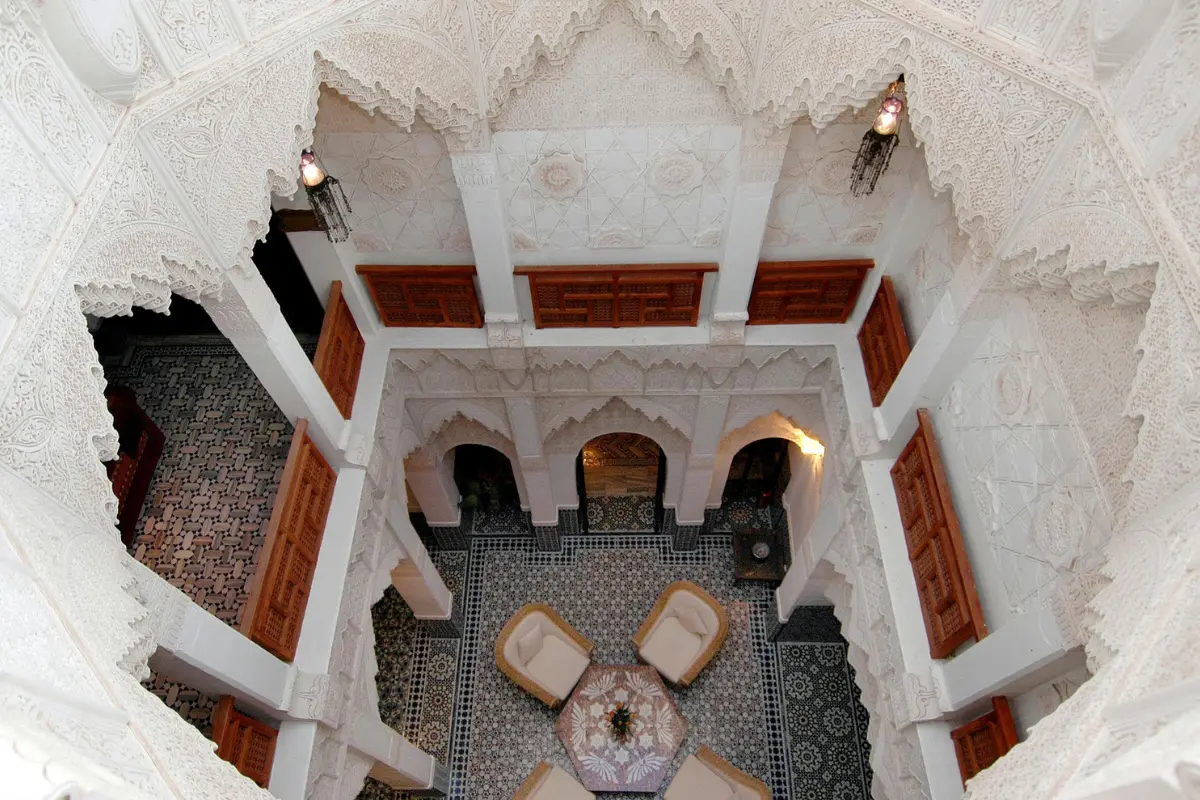
A RIAD is a traditional Moroccan house where everything revolves around the inner courtyard that has a main fountain filled with flower petals (the wealthiest riads even have a swimming pool). A riad doesnʼt have as many rooms as a hotel, and all of the rooms feature a unique traditional (or eclectic in style) decorations such as: zellige (a geometric mosaic decorations on the floor and on the walls), woodcarvings, and marble stuccowork. Every room of the riad is a unique artistic and handicraft expression, and they have no outer windows, but are all turned toward the main courtyard allowing for a
total privacy, silence, and fresh air that could never be attained from the street windows. The wealth of the owners reveals itself only when one enters this private heaven. The riads are real palaces, an exceptional delight to visit, and even more so, to stay in! We believe a loving Moroccan tour needs to allow its guests to experience riadʼs luxury, charm, and hospitality.
We are eclectic in our ways, and love to cross the lines between different disciplines. We combine the most interesting of each of them. Some of the topics we cover in depth, and some we take in as we go along. We avoid academic teaching style and aim at bringing new insights in a relaxed manner, with humor and with with ease, yet professional.
Zellige mosaic, cedar wood carving, marble stuccowork, calligraphy, metal (Alpaca) or wooden door with brass door knobs, ceramics, leather, and more
Architcture and handcrafts, painting
Precious moroccan calligraphy is a feast for the eyes. We try our hands at this ancient skill
A must is a visit to the Medersa (a Coranic school), and the Yves Saint Laurent garden and museum in Marrakesh
Yves Saint Laurent in Marrakesh and the designers of Morocco
Djellaba, Kaftan, Gandora and everything in between
Mosques, minarets, islamic schools (Medersas), Marabouts (tombs of local saints), medieval cities (Medinas), Ville Nouvelle- New Towns (French colonial architecture), Art Deco and Art Nouveau builidings (built by the French)
UNESCOʼs world heritage sites: Medina (Old town) of Fes; the Jma El Fna square and Medina of Marrakesh; the historic city of Meknes; ksar Ait Ben Haddou; the modern capital, and the historic city of Rabat
Richness of traditional and modern Moroccan (and Maghrebian) music
Berber and Arab dance
Awaiting for the new Grand Theatre de Rabat, commissioned from Zaha Hadid Architects, to be opened in Rabat (one day soon, inchallah)
The Moroccan “architectural Trinity”: a Riad, a Kasbah, and a Ksar
Strong multiculturalism: Muslims Arab and Berber traditions, with European influences; Islamic traditions and rituals
- Before the arrival of Islam: indigenous people, the Berbers and the Jews
- The arrival of Islam, followed by six Moroccan dynasties (the Sultans of Morocco), conquering of Andalusia in Spain
- Contemporary Morocco and the 6th dynasty of Alavites
Why the surroundings, country, city, environment is as it is; looking at the spaces and understanding how they function, learning about the social and cultural forces that shape the life of Moroccans and Morocco
The excellent cuisine with rare Moroccan wines (they produce a few of them). We are also exploring the Moroccan teas (with cookies, or other lovely deserts)
we prefer useful knowledge, interesting insights, and lovingly brought presentations.
*We include politics as much as needed to understand the environment and the visited culture and no more.
Morocco is a moderately safe country – tourist crime rates are low and mostly consist of petty thievery of non-attended items, so we advise our guests to always use common sense (to keep their valuables in the safety box in the room, avoid exposing expensive cameras, and in city centres always take care of personal belongings). Every now and then, the risk of terrorism grows, so we avoid crowded places as much as we can, and always keep an eye on happenings around us. We also have a very reliable local partner who follows the latest safety announcements and news instructions.
Standard Arabic and Amazigh language (Standard Moroccan Berber). Other spoken languages: French, Spanish (in some parts) and English (tourist places)
CURRENCY: Moroccan Dirham- Dh or Mad
CREDIT CARDS: accepted in tourist places, but Morocco is a country of cash
ATMs in the cities
PRICES: 0.5l water 10 Dh (roughly 1 Eur), fresh orange juice or other fruit juices from 15 to 20 Dh, lunch in a good restaurant in the cities from 250 Dh, tea or coffee in a cafe from 20 Dh
The muslim culture is a culture of cooperation and care for others and for the society. Every Moroccan usually takes care of their extended family, elderly parents and their underaged siblings. In a country that has a low average salary and big poverty, the people appreciate tips very much and accept them gratefully.
In some areas (south of the Atlas mountains) there is a shortage on daily necessities and people are happy to receive basic food, clothes (old T-shirts), small (mini) toys for children, candles, baseball hats (for boys and men). We like the idea of presenting the (more educated) people in the towns with postcards of the visitorʼs home country (or home town). Note: not to bring: alcohol, or any kind of pork.
Wifi is available at all Riads and hotels, 5G in the phones (roaming can be quite pricey, but itʼs possible to buy a Moroccan SIM card and use a Moroccan connection).
Moroccans do not like to be photographed! If they do pose, they will expect some reward for it (a small tip of 5 Dh/ 0.5 eur).
For non-muslims the Moroccan mosques are off-limits. There are a few, though that open their door for such visitors. When possible, we visit one of them in Casablanca- Hassan II Mosque.
Guests should wear clothes they feel comfortable in and beautiful wearing. Keep in mind the Moroccan climate (strong sun) and a few long transfer days (for more information on the program, please send as an inquiry and we will send you the program of the tour or find the specific tour in our Departures page), and take care that comfort on the move, and protection from the sun come before elegance. Morocco is a muslim country, and we believe respect toward the visited culture brings respect toward the visitor, so we suggest modest clothes that cover your knees and shoulders (or even better – a full length dress for the ladies, especially in the rural areas) and with no cleavage for the ladies. The best fit for travel in Morocco are tunics with loose fitting pants and shirts with mid/long sleeves and long shorts for gentlemen. A nice airy and beautiful scarf is, in a sunny country, always a good protection from the sun and a nice fashion accessory, and can be altered with a sun hat.
OUR SUGGESTIONS on what to wear- dress code:
Our guest’s luggage is taken care of, so they do not need to worry about carrying heavy suitcases in and out of the hotels and riads, and onto the coach.
DISHES: couscous topped with meat or vegetables, tajine, bastilla, lamb with prunes, kefta meatball tajine, harira soup. MEAT: beef, chicken, mutton, lamb, sheep, goat, snails, pigeons (in a traditional Bastilla pie) and seafood (mostly at the seaside and in Marrakesh). Moroccans do not eat pork due to their religious restrictions. SPICES: Morocco is a land of spices. They use a lot of home grown saffron, mint, cinnamon, turmeric, (oriental) cumin, ginger, paprika, coriander, nutmeg, cayenne pepper, sesame seeds, cloves, fennel, anise, garlic, and others. The traditional mixture of 35 spices is called Ras-el-Hanout (the expression means “head of the shop,” as it is the best they sell in a shop). HERBS: mint, parsley, oregano, coriander, marjoram, sage, and verbena. FRUIT: oranges, tangerines, strawberries, fresh and preserved olives, lemons. Dried fruits: sultanas, raisins, apricots, dates (from the south of the country). VEGETABLES: aubergine, tomato, onion, green peppers, spinach, potato and sweet potatoes, chickpeas, carrots, cabbage, turnip, fava beans, squash, zucchini, broccoli, and more. DRINKS: this is a land of green tea with fresh mint leaves and a lot of sugar. To learn how to properly pour the tea into a small, painted glass, read in our Blog. Moroccans also drink coffee (with milk, or black), and they also prepare very tasty smoothies (avocado, bananes, strawberries, and others) and fresh orange juice. Moroccans do not drink alcohol due to their religious restrictions, but in all the hotels, they sell imported (or some local) wines, beer, and imported spirits. OILS: olive oil and precious argan oil. OTHER: Amlou is a healthy spread or a dip made of argan oil, mixed with grinded roasted almonds and argan flower honey. Moroccans believe that Amlou is also an aphrodisiac
A TRADITIONAL MOROCCAN BREAKFAST
BREAKFAST IN THE HOTELS: traditionally mostly continental French style breakfast (tea/coffee, croissant, bread, butter and jam, cheese or omelette), in the 5- star hotels they have a vast variety of different breakfasts
In Morocco there are many souvenirs to buy, so it is a good idea to have a very relaxed kilogram allowance for the plane, or to be ok with paying for the extra baggage. Bigger items can be shipped abroad.
What to buy: argan oil, babouch leather slippers, and leather items, Djellaba dress, berber baskets or market bags, bread baskets, hammered metalworks, musical instruments, Gnawa music instruments, Ras-el-Hanout spices and other spices (saffron), dried dates, tea, artisanal soaps, or Rassoul and a hammam glove- Kiss, lanterns, berber rugs and carpets, together with matching pillow covers, woven goods, pottery and Zellige (tile work), wooden items, coloured tea cups and metal tea pots, tea sets, fossils (made into a bathroom sink), ect. – and a Fes hat.