In Morocco when you walk among the Roman ruins of Volubilis, the stones still remember the heat of the old Roman public and private baths. Romans carried their love for water, for cleansing and communal ritual, wherever their empire reached. Meaning even into the dust of North Africa.
Centuries later, soon after the Arabs brought Islam, they brought the Arabic ritual of hammam with them. In a desert world where stubborn dust clings to skin, the act of washing became more than hygiene and socializing. It became spiritual, the cleansing of Body and Soul.
The hammam was born. It was rooted in Roman and Byzantine public baths, was carried forward into the Islamic world, and is now an integral part of Moroccan daily life. A hammam is a 2000 years old institution, reborn into its present day 1300 years ago. The word comes from Arabic and it literally means “of the heat” or even “strong heat”.
Faces of the Moroccan Hammam
Today in Morocco, hammams appear in many forms:
• The most elegant hotel Spas, tiled to perfection, silver trays ready for tea, oriental scents in the air, candles under the horse shoe shaped arches with elegance at their core. • Public Hammams, crowded and raw, where whole neighborhoods gather before Friday prayers or religious holidays. • And the historic Hammams with hidden entrances in old Medinas, their walls soaked with centuries of steam, sweat and conversations.
On my Moroccan journey, I choose the third. Not the polished spa, not the overwhelming public bath, but the authentic historic hammam. In the heart of Fes. After a long day exploring the medieval Medina, this is where we slow down, leave the world outside, and step into a cultural shock experience, into a truly traditional Moroccan experience.
More Than a Spa
In the West, we often confuse the hammam with a spa treatment. It is not.
A hammam is not about luxury atmosphere, products or quiet background music. It is about the time with yourself, and with other women (if you are a man- then other men). Time away from the streets, the markets, and everyday errands.
It is teasing and laughter. It is silence and letting go. It is purification before prayer, a sacred preparation before holidays. Even today, Moroccans often go on Thursday evening, before their sacred day, Friday.
But whatever its form, the hammam is Social and in a way, Sacred.
And it has always been this way. In the Middle Ages, when much of Europe drowned in its own filth, Islamic culture stretched from India to Spain. There men and women washed daily, and entire communities gathered weekly in public baths. Hygiene here was practical, yes, but more than that, it was spiritual, cultural, and in its core, social.
Crossing the Borders of Nakedness
And then comes – the cultural shock.
In the women’s section of the hammam (and I had only ever seen the ladies’ part), there are no swimsuits. Only- nakedness. And contrary to our, Western beliefs, it is not at all sexual. Simply bodies, as they are. Not posed, nor shy, not hiding, nor showing off. Just as nature intended us to be. And that for us sometimes is a real shock to experience.
When was the last time someone else washed you? Three years old? Five? Your mother’s hands in your hair?
That is what happens here. Women scrub you, and they scrub each other. Strong hands turn you around on warm marble tables as though you were meat in a butcher’s shop. There is no hesitation, no lingering touch. It is their skilled work, and an every day’s routine.
At first, it feels vulnerable. Borders are being crossed. Eyes lowered. Bodies shy. But slowly, something shifts. Nakedness becomes easier. You start feeling safe and start sharing the room with them.
In that safety, something else awakens. A sense of Sisterhood.
The Ritual of the Moroccan Hammam in Full
Arrival and Atmosphere
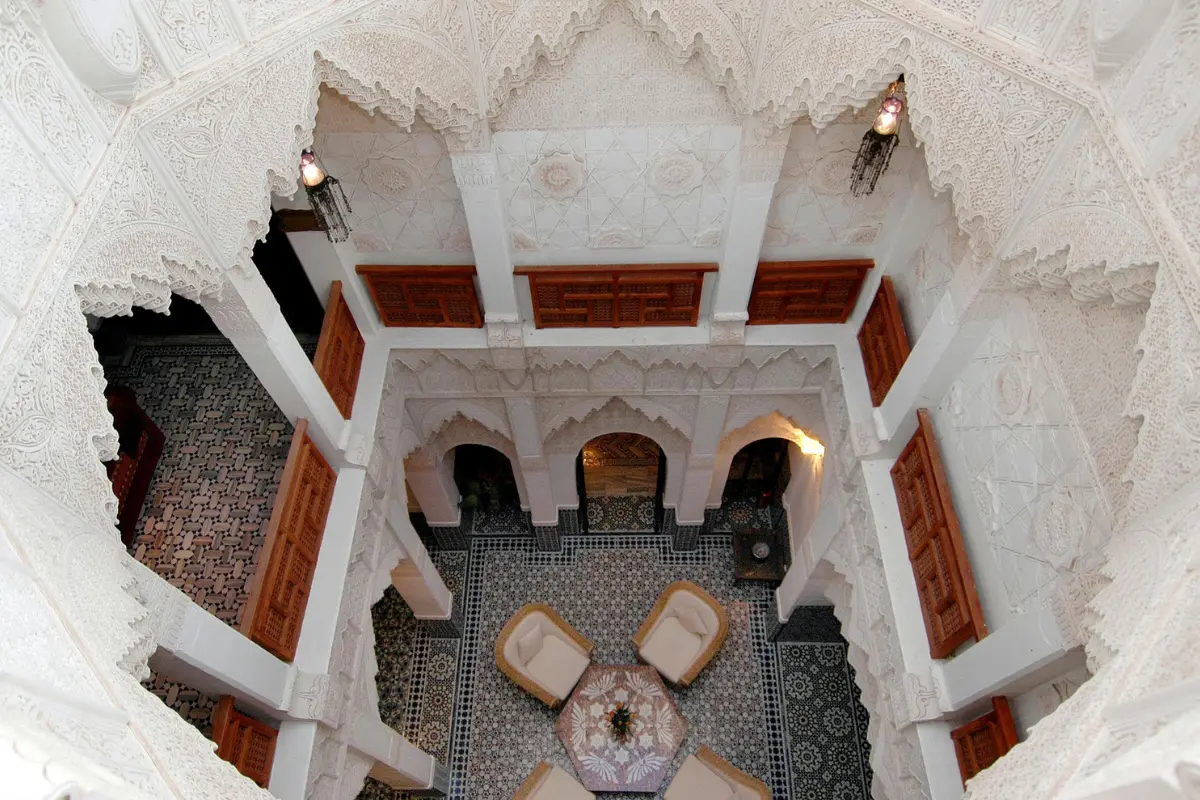
You enter through the old wooden door into a quiet corridor. Mosaics escort you on your way. At the reception hall tea is served on low tables, and people are sitting on low benches, popular in all Moroccan households, past and present.
Here the magic begins. Hammam unfolds like a slow dance choreography. At first you feel lost, and want to know what exactly will happen and when. Nobody tells you that. And as you let go, things start to happen on their own, with no effort.
You are led into a dressing room. You can feel the heat every time they open the wooden door into the heart of the hammam.
A robe, slippers, and a fresh Kessa glove are handed to you. You leave everything else behind.
Steam and Cleansing
Inside, steam fills the dome. Light is dim, filtered through tiny holes in the ceiling. Naked bodies lie on warm marble slabs, water splashing from endless buckets. At first it feels surreal, almost otherworldly. As if time has stopped.
And then the Ritual begins: • First, lathered soap and buckets of water poured head to toe. • Then Savon Noir, the sticky black soap made from pressed olives, and cascades of water. • Then the scrubbing, rough or gentle, depending on what you ask. Layers of dead skin roll away in ribbons. You feel a bit embarrassed when they show you all that is leaving your body. And more water splashing over you. • Then your hair and scalp are washed, sometimes exfoliated with a round hair brush. • Then Rhassoul clay, gray and cooling, painted over your skin and hair. • Then another cascade of water, as if water is sent directly from God. It never stops.
Finally, you are wrapped in your towel coat like a little child, and led to a quiet room lit by candles. You get a towel, a bottle of water, and a chair for resting while you wait for the final stage.
Rest and Nourishment
They invite you in for an argan oil massage. This is not as much a luxury, as it is a nourishment. It doesn’t last long, just enough for the oil to be absorbed.You emerge softened, your skin soft as a baby, your mind quiet, and your Soul… well, the Soul is now closer to Allah, for sure.
And always, at the end …
… there is tea. Mint tea and sometimes also small cookies.
Why I Include the Hammam
I would never offer a journey through Morocco without an experience of a hammam.
It is not always easy. It can be overwhelming. For some, it feels too intimate, and too raw. But for most, once the initial shock softens, it becomes one of the most memorable, transformative experiences of the whole Moroccan Journey.
A hammam is much more than cleansing the skin.
It is the connection. To your body, to other women.
It is accepting yourself in a new way. It is about leaving the world outside and stepping into something intimate and almost sacred.
And that, to me, is the essence of travel.
Not only to see, but to gain a new insight in other peoples’ lifes and maybe… just maybe… a small change in you, too.
Have you ever experienced the traditional Moroccan hammam?
⚜️ Elegant Cultural Tours, guiding you into the living Rituals in Morocco.
“Join me for an authentic Moroccan hammam experience in Fes, part of our carefully curated Elegant Cultural Tours.”